
In South Africa, more and more small businesses and creatives are relying entirely on Instagram, Facebook, or WhatsApp to find clients. And while those platforms absolutely have a role to play, building your entire business on them is like building a house on rented land. At any point, the algorithm changes, your account gets restricted, or the platform loses popularity, and suddenly your entire online presence is at risk.
A website, on the other hand, is yours. Your domain, your content, your rules.
You Control Your Own First Impression
When a potential client searches for your business or your service category, what do they find? If you only have a Facebook page, they find whatever Facebook decides to show them, surrounded by ads and other distractions. If you have a proper website, they land exactly where you want them to land, with exactly the information you want them to see first.
That level of control over your brand story is something social media can never fully give you.
People Search Before They Buy
Think about the last time you wanted to find a local service. You probably typed something into Google. Almost every buying journey in South Africa now starts with a search. Businesses without a website are invisible to that massive pool of potential customers.
Even if someone hears about you by word of mouth, the first thing they are going to do is Google you to check if you are real and what you offer. If they cannot find a website, many will simply move on to someone they can verify online.
A Website Works for You Around the Clock
Your staff have working hours. Your website does not. A well-built website can answer questions, showcase your work, generate leads, and even process orders while you sleep. For a small business owner who is already doing ten jobs at once, having a digital employee that never takes a day off is genuinely valuable.
This is especially true if you sell physical products. An ecommerce-enabled website lets customers browse and buy at 11pm on a Sunday, which is often exactly when they are in the mood to shop.
It Builds Credibility in a Way Social Media Cannot
South African consumers are savvy. They have been burned by fly-by-night operators, and they are cautious. A proper website with clear contact details, a physical address, customer reviews, and a portfolio of your work signals legitimacy in a way a social media profile simply cannot replicate.
It says: we have been here, we have done the work, and we are not going anywhere.
For Creatives Especially, Your Work Deserves Better Than a Grid
If you are a photographer, designer, stylist, or any kind of creative, your work deserves to be presented properly. Instagram is designed for quick consumption, not careful appreciation. A website lets you curate how your work is displayed, tell the story behind it, and give potential clients the full picture rather than a cropped square.
Your Competitors Already Have One
In most industries in South Africa, the businesses that are growing are the ones that have invested in a proper online presence. If your competitors have a website and you do not, every customer who searches online and finds them instead of you is a customer you are losing passively. You are not even in the race.
This is especially true in Gauteng, where consumer expectations around online presence have risen sharply in the last few years. Customers expect to be able to find your hours, see your work, read some reviews, and contact you online before they commit to visiting or calling. A business that makes this difficult loses a percentage of potential customers before any conversation even begins.
A Website Supports Everything Else You Do
A website does not replace your social media or your word-of-mouth marketing. It supports them. When you share a post on Instagram, the natural next step for an interested customer is to visit your website to learn more. When someone recommends you to a colleague, the colleague Googles you. Your website is the hub that all your other marketing channels point toward.
Without it, your other marketing efforts are less efficient. You are doing the work of getting people interested, then sending them nowhere. A well-built website closes that loop and turns interest into enquiries, and enquiries into clients. For businesses in Midrand specifically, a localised website that mentions your area, your address, and your service zone also helps you rank in local Google searches, which is often where the highest-intent customers come from.
Getting Started Does Not Have to Be Complicated
The most common reason small businesses in South Africa put off building a website is that it feels complicated and expensive. It does not have to be either. A focused, well-built five-page website that clearly explains who you are, what you offer, and how to get in touch will outperform a bloated, over-designed site every time.
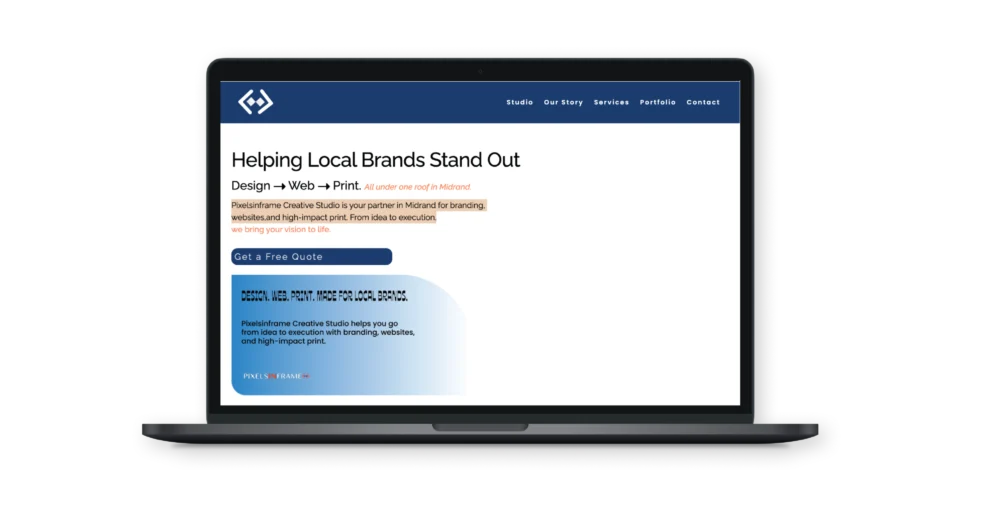
At Pixels In Frame, we build websites for small businesses and creatives in Midrand and across Gauteng that are clear, fast, mobile-friendly, and built to actually convert visitors into customers. See what we offer here.